.png)
Mô tả
World Steel Price Update
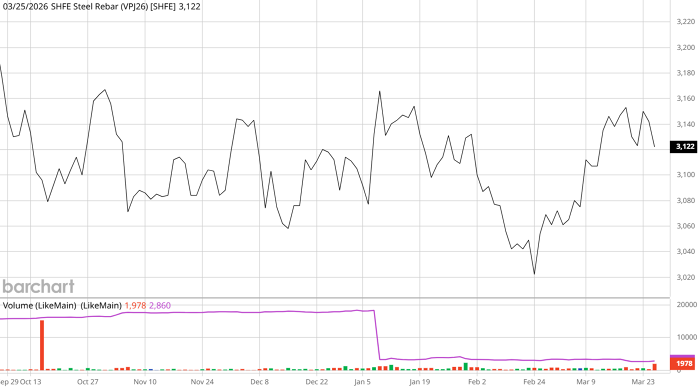
At the close of trading on March 25, the price of April 2026 rebar futures on the Shanghai Futures Exchange fell 0.64% (20 yuan) to 3,122 yuan/tonne. On the Dalian Commodity Exchange, the price of April 2026 iron ore futures fell 0.84% (7 yuan) to 826.5 yuan/tonne. On the Singapore Exchange, the price of April 2026 iron ore futures fell 2.48% to 105.19 USD/tonne.

Price movements of April 2026 rebar futures on the SHFE. Source: Barchart
Iron ore futures prices fell after a series of three consecutive days of gains, as the market was pressured by concerns about steel production cuts in China, particularly in Tangshan city. However, the decline was limited by supply disruption risks from Australia, according to Reuters.
The most actively traded May 2026 iron ore contract on the Dalian Commodity Exchange (DCE) fell 1.83% to 806.5 yuan/tonne, or $116.96/tonne. Meanwhile, the benchmark April iron ore contract on the Singapore Exchange fell 2.29% to $105.2/tonne.
Market pressure intensified after Tangshan – a major steelmaking center in China – activated a Level 2 air pollution alert on March 25th, according to a local government announcement on WeChat. This move raised concerns that steel mills would have to cut production and face stricter environmental inspections.
Data from the World Steel Association showed global crude steel output in February fell 2.2% year-on-year to 141.8 million tonnes. China – the world's largest producer and consumer of steel – recorded a 3.6% decrease in production to 76.1 million tonnes.
The prolonged oversupply in China continues to put pressure on steel prices and mill profit margins. Earlier, Beijing reaffirmed its commitment to cutting steel production this month, reinforcing expectations of weakening iron ore demand and driving prices down.
However, the market did not fall too sharply due to concerns about supply from Australia – the world's largest iron ore exporter. A tropical storm is forming off the northeast coast of the country, potentially affecting mining and shipping operations.
According to the Australian Bureau of Meteorology and analysis from ANZ, the storm has forced the evacuation of Port Hedland – the world's largest iron ore export port. In addition, open-pit mines may also be affected by the storm.
On the DCE, other input materials for steel production saw coking coal and coke prices fall by 1.78% and 1.82%, respectively.
On the Shanghai Futures Exchange, key steel products mostly declined, including rebar (down 0.41%), hot-rolled coil (down 0.24%), and wire rod (down 0.33%). Conversely, stainless steel rose by 1.26%.
Domestic Steel Price Update
In domestic area, businesses are stabilizing construction steel prices. Specifically, Hoa Phat quoted CB240 steel at 14,920 VND/kg and D10 CB300 steel at 15,020 VND/kg.
Similarly, Viet Y Steel Northern recorded CB240 and D10 CB300 steel prices at 14,800 and 14,700 VND/kg, respectively. Viet Duc Steel Northern Vietnam recorded prices for both CB240 and CB300 at 14,800 VND/kg. Meanwhile, other companies such as VJS Steel Northern Vietnam, Pomina, and Southern Steel maintained stable prices.

Steel prices recorded as of March 26, 2026. Source: SteelOnline
Source: VietnamBiz

.png)

.png)