.png)
Mô tả
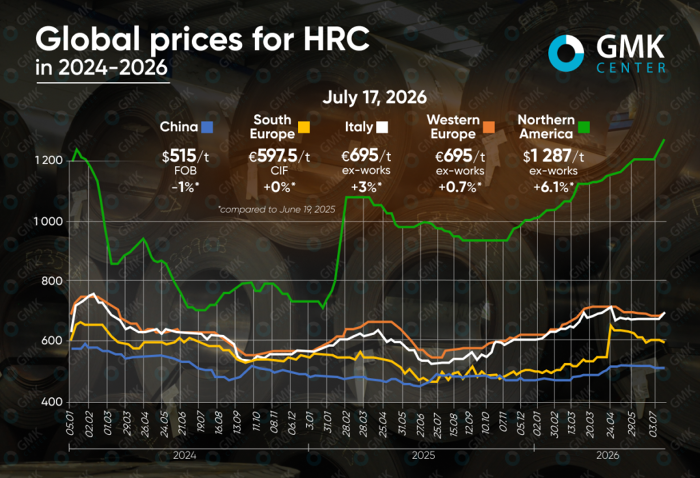
The global hot-rolled coil (HRC) market saw mixed trends in July 2026. In the US, prices continued to rise due to tight spot supply and stable demand. In Italy, prices were supported by the European Union's (EU) tightening of import quotas, according to the consulting firm GMK Center.
Meanwhile, Western and Southern European markets were generally flat due to weak demand and high inventory levels. In China, seasonal trading slowdowns, poor export performance, and increased inventories put downward pressure on steel prices.
Europe
Hot-rolled coil (HRC) prices in Europe were generally stable from June 19th to July 17th. In Western Europe, prices increased by 0.7%, to 695 euros/tonne ex-works (EXW). Meanwhile, import prices in Southern Europe remained unchanged at €597.5/tonne, CIF terms (including goods, insurance, and freight). In Italy, the market was more positive, with prices rising 3% to €695/tonne ex-works.
On average in July, HRC prices in Western Europe reached €688.33/tonne, almost unchanged from €688.75/tonne in June, a decrease of 0.1% compared to the previous month. In Southern Europe, the average price reached €602.5/tonne, down 0.9% from €608.1/tonne in June. Meanwhile, the average price in Italy reached €681.7/tonne, up 1% from €675/tonne in the previous month.
At the end of June, steel prices were under pressure due to low demand from industrial consumers and large inventories at service centers. To boost sales and free up working capital, distributors intensified price competition, offering prices close to those of mills. In Italy, buyers also limited signing large contracts while awaiting final guidance on the new import mechanism.
Market sentiment improved after the European Union (EU) announced stricter tariff quotas. Reduced supply from key exporting countries, rapid filling of some quotas, and increased out-of-quota tariffs of 50% significantly narrowed alternatives to European rolled steel. As a result, producers announced price increases of €20/tonne in Northwest Europe and up to €50/tonne in Southern Europe. However, weak demand from end consumers, summer production shutdowns, and high inventory levels mean that new price levels are not yet widely accepted in contracts.
Entering August, the market is expected to remain sluggish. However, by fall, inventory restocking and declining steel imports could create conditions for gradual price increases.
USA
In the US market, hot-rolled coil (HRC) steel prices increased by 6.1% between June 19 and July 17, reaching $1,286.9 per ton ex-works (EXW). The average offer price in July reached $1,252 per ton, up 3.3% from $1,212.5 per ton in June.
The upward trend in steel prices is mainly supported by tight spot supply and stable demand from key consuming industries. The automotive sector recorded better-than-expected results, while steel pipe manufacturers serving the energy sector maintained high production capacity. Demand from the construction and home appliance manufacturing sectors also remained generally stable. In addition, scheduled maintenance and disruptions at some plants limited the ability to add supply in the short term.
At the end of June, after five consecutive months of price increases, Nucor Group temporarily halted price adjustments and maintained its offer price at $1,130/short ton. This move was seen as a signal that the market was entering a stable phase during the holiday season. However, by mid-July, the company raised prices again by $5/ton. In fact, many transactions were closed at prices higher than the reference price due to large order volumes and extended delivery times. Meanwhile, cheap imported steel, especially from Asia, remained a limiting factor in the market's upward momentum.
In the near future, HRC prices in the US are projected to remain high. However, weakening seasonal demand and gradually recovering supply may limit the likelihood of further sharp price increases.
China
In China, hot-rolled coil (HRC) prices fell 1% last month to $515/ton FOB (delivered on board). The average price in July was $515/ton, down from $519/ton in June, indicating a slowdown in the upward trend.
In late June and early July, the market was pressured by weakening seasonal demand, falling futures prices, and increasing inventories. Heavy rains in southern China and prolonged heatwaves in eastern China slowed trading activity. Most businesses only purchased steel to meet immediate needs.
In the export sector, large orders remain limited. Amid competition from cheaper steel sources exempt from value-added tax (VAT), mills and traders lowered their offers to below $510/ton FOB.
By mid-July, domestic steel prices recovered slightly due to rising futures prices, increased iron ore costs, and production cuts.
In some localities, however, actual demand shows no signs of improvement. Furthermore, risks to shipping through the Strait of Hormuz continue to increase uncertainty for exports. According to GMK Center, HRC prices in China are expected to remain under pressure until the end of summer. A sustainable recovery is only possible when seasonal demand increases again and supply shrinks.
.jpg)


